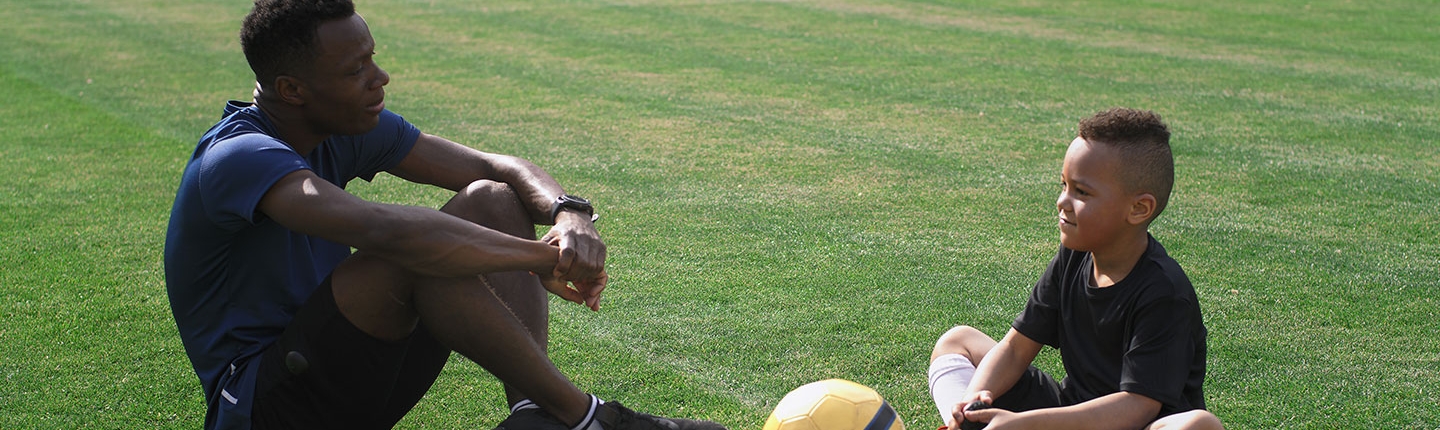
Summer sports camps and seasons are in full swing. Many parents and caregivers wonder what to say to kids after games, especially after a tough loss or disappointing performance. Below are seven tips to help make your postgame conversations with young athletes more supportive, helpful and productive.
- Check your emotions first.
As caregivers, it can be easy to get emotionally invested in our child’s sports. We drive them to games and practices, pay for sports and buy sports gear. It can also be hard to watch your child lose or not play well. Feeling upset, frustrated, worried and sad after a loss or poor performance is normal. But behaviors like yelling or kicking can lead to bigger problems. If we show kids that we can feel frustrated without yelling or stomping off, they are more likely to do the same. By taking a minute to check your own emotions before a postgame conversation, you are showing them how to handle theirs. It is OK to share your feelings too. For example, you can say you feel frustrated by the outcome. Just make sure you stay in control and avoid yelling or talking poorly about referees or coaches.
- Validate the emotion.
Just as it is OK for you to have strong feelings about the outcome, it is OK for your child to feel sad or frustrated too. As caregivers, it is important to validate those feelings. That means noticing the feeling and naming it. It does not mean you agree with every behavior that comes with it. Often, parents try to make things better by saying, “It’s just a game” or “You’ll get them next time.” These phrases mean well. But when kids already feel frustrated or sad, they can sound dismissive. Helping kids name and validate their feelings can make those emotions easier to handle.
- Give athletes space to wind down.
You know your athlete best. Some athletes need space after a loss before they are ready to talk. Others may need a hug. Some may want to try calming strategies together, like taking deep breaths.
- Help your athletes identify what they want to take away from the game.
It is natural to focus on the outcome of a game. But the final score only tells part of the story. Sports, and life, are more complicated than that. Help your athletes look at both the good and the bad. What did they do well? Where did they improve since the last game? What do they want to work on in practice in the coming weeks? For many athletes, this conversation goes better a few hours later or even the next day. And if your athlete does not want to talk to you, seek out coaches who take a developmental approach.
- Emphasize progress over perfection.
We all want our children to succeed. But that will not happen every game, and that is actually OK. Not winning every time, and continuing to try, helps kids build resilience. Helping athletes see their progress, even when the outcome is disappointing, can keep them motivated and engaged in sports.
- Before the game, help athletes set behaviorally specific goals.
If you have the chance before a game, or even at the start of a season, help your child set goals they can control. Winning can still be a goal, but it should not be the only one. It helps to focus on goals they can measure and work toward over time. After the game, you can look back at those goals together. That gives you a chance to praise specific actions, no matter what the final score was. It also supports progress over perfection.
- Use real–world examples.
The world is full of sports, so there is almost always a game, match, meet, tournament or competition happening. Find examples of college or professional athletes who lost and came back stronger the next year. Look for quotes from those athletes and talk about their journeys with your child. This can help normalize both winning and losing. It can also be easier to talk about someone else’s performance first. That can make it easier to start a conversation about your own athlete’s experience.




 https://riseandshine.childrensnational.org/wp-content/uploads/2024/10/Medical-symbol-with-stars-Feature.png
300
400
Danielle Robbins
https://riseandshine.childrensnational.org/wp-content/uploads/2017/11/childrens_riseandshine_logo.jpg
Danielle Robbins2026-09-03 07:00:302026-09-03 10:37:52What are hospital rankings?
https://riseandshine.childrensnational.org/wp-content/uploads/2024/10/Medical-symbol-with-stars-Feature.png
300
400
Danielle Robbins
https://riseandshine.childrensnational.org/wp-content/uploads/2017/11/childrens_riseandshine_logo.jpg
Danielle Robbins2026-09-03 07:00:302026-09-03 10:37:52What are hospital rankings?








Posts from Chelsey Bowman, PhD
Seven tips for talking to young athletes after games
Doom and Gloom: COVID-19 fears and January
How do I get a 7-year-old child to stop screaming when she doesn’t get her way?